Farmhouse Fence: What It Is and How Much It Takes
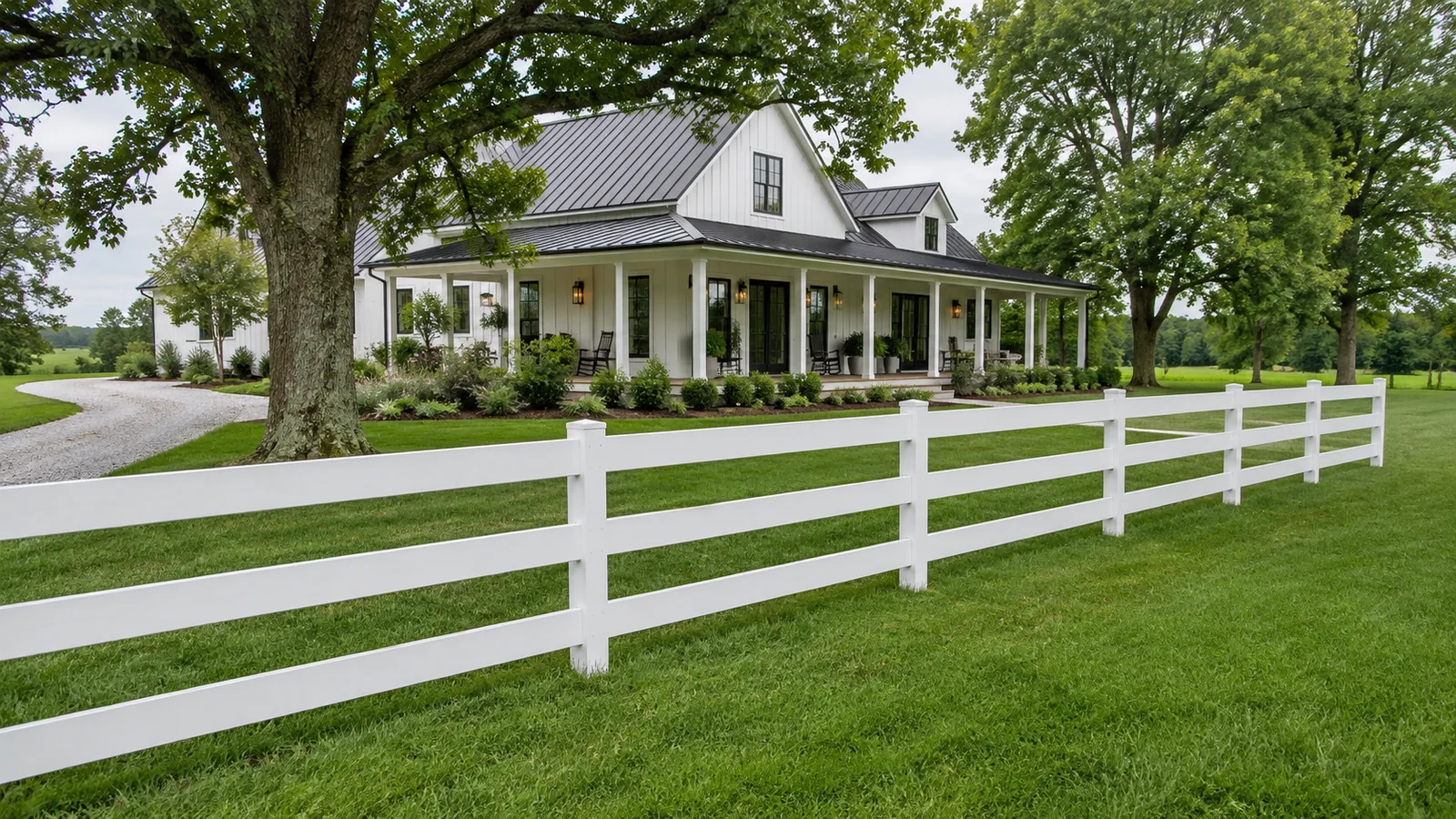
A farmhouse fence is an open board fence: three or four horizontal boards nailed across the faces of wood posts, painted white or black or left bare. Along a 300-ft road frontage with one 12-ft drive gate and posts 8 ft apart, the 3-board version takes 39 posts and 108 board spans of 8 ft, or 114 with 5% waste.
Updated
37 line + 2 gate, 4x4
With 5% waste: 114 rails.
Hole: 10 in diameter x 2 ft deep, 0.92 cu ft per post.
Total: 78 bags (80 lb) / 117 bags (60 lb) / 117 bags (50 lb) for 39 posts, 35.91 cu ft.
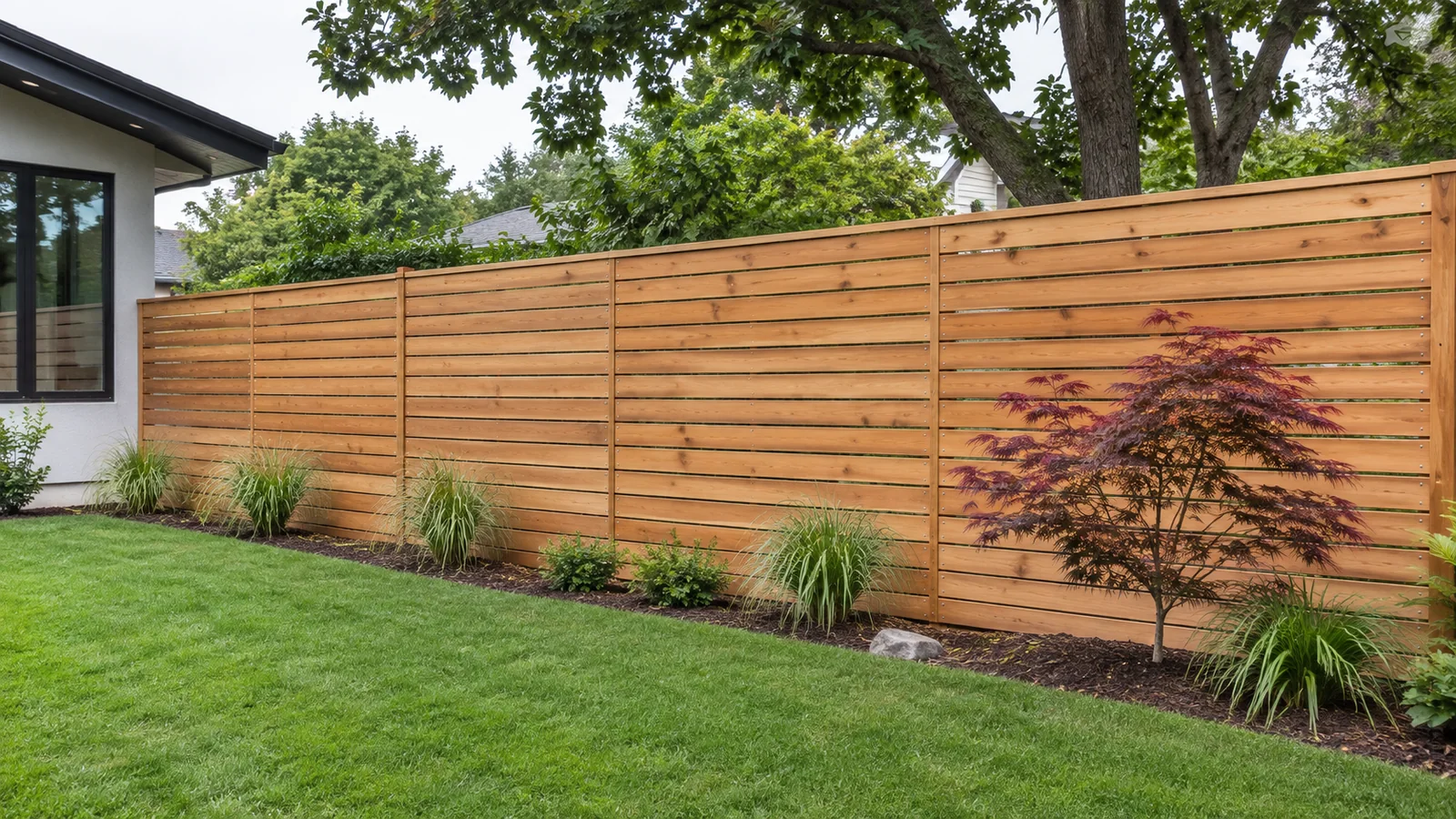
The calculator above opens on the front of a farmhouse lot: 300 ft along the road, 4 ft tall, a 12-ft drive gate where the lane comes in, and 4×4 posts 8 ft on center. It is the only open board layout in the fence styles section. The boards leave wide gaps, so the fence marks a line and holds animals without blocking the view. Close those gaps to a half inch and the same post-to-post boards become a horizontal fence.
How many boards does a farmhouse fence need?
The calculator gives every section three boards, one above the other, and counts each one as a single 8-ft span from post to post. Height does not change that number at 4 or 5 ft. Neither do board width or thickness, because the count is a number of spans and not an amount of lumber.
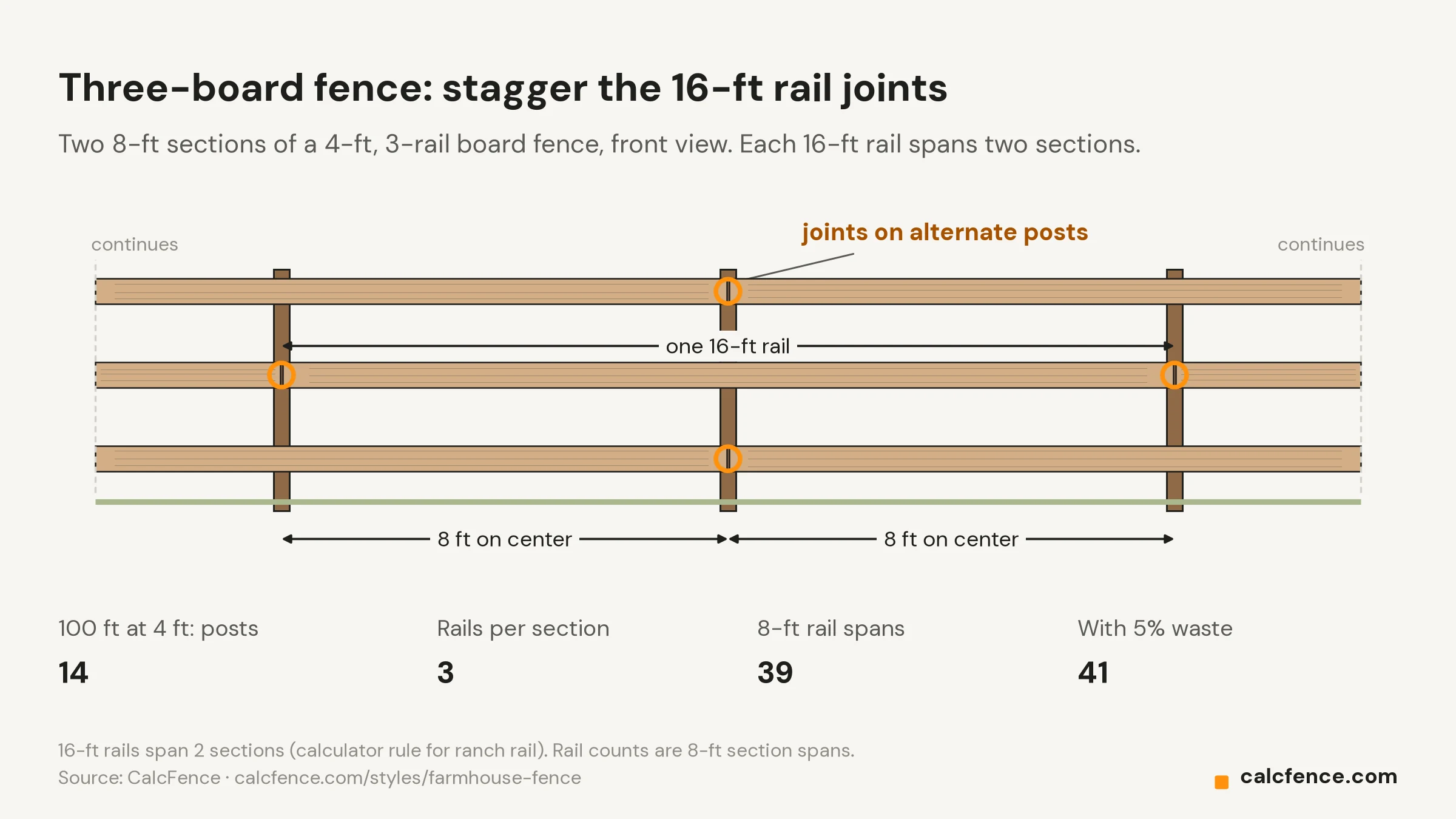
Buy 16-ft boards and each one runs across two sections, with the joints falling on alternate posts as in the drawing. The calculator does not count 16-ft boards. It lists 8-ft spans, and pairing them up is your step: on an even number of sections, halve the span count. UGA Extension's Fences for Horses (Bulletin 1192, reviewed May 31, 2024) gives the matching rule from the other side: with posts every 8 ft, board length "should be an even multiple of 8 ft."
The 300-ft road frontage, counted
Inputs: straight run of 300 ft, 4 ft tall, one 12-ft drive gate, posts 8 ft apart, 4×4 posts, 5% waste on.
| Line | Quantity | What sets it |
|---|---|---|
| Fence line | 288 ft | 300 ft minus the gate opening |
| Sections | 36 | 288 ÷ 8, no remainder |
| Posts | 39, each 8 ft long | 37 line posts and 2 gate posts, buried 2 ft |
| Board spans | 108, or 114 with waste | 3 per section, each 8 ft |
| 16-ft boards | 54, or 57 with waste | your pairing of the spans above, not a calculator line |
| Concrete | 78 bags of 80-lb mix | 2 bags per 10-in hole |
The fastener line in the result reads 0 for this style. The calculator counts nails and screws only where pickets cross rails, and a board fence has no pickets, so the nails or lag screws for 108 board ends are yours to add. The gate leaf and its hardware are not on the list either.
If the frontage turns a corner and runs 150 ft along the road and 150 ft down the lane, enter both sides under Multiple Runs. The gate comes off one side, each side rounds to whole sections on its own, and the list grows to 37 sections and 40 posts.
Ranch fence, post and rail, split rail
The names overlap. Ranch fence and post and rail fence can mean this build, with sawn boards fastened to the post faces, or split rail, with rough rails slotted through holes in the posts and no nails. Horse fence and 3 board fence mean the boarded kind. The split rail fence cost calculator prices that version. In the calculator, the split rail style sets posts 10 ft apart and lets you pick 2 or 3 rails, while the ranch rail style stays at 8 ft and three boards.
Building it as a horse fence
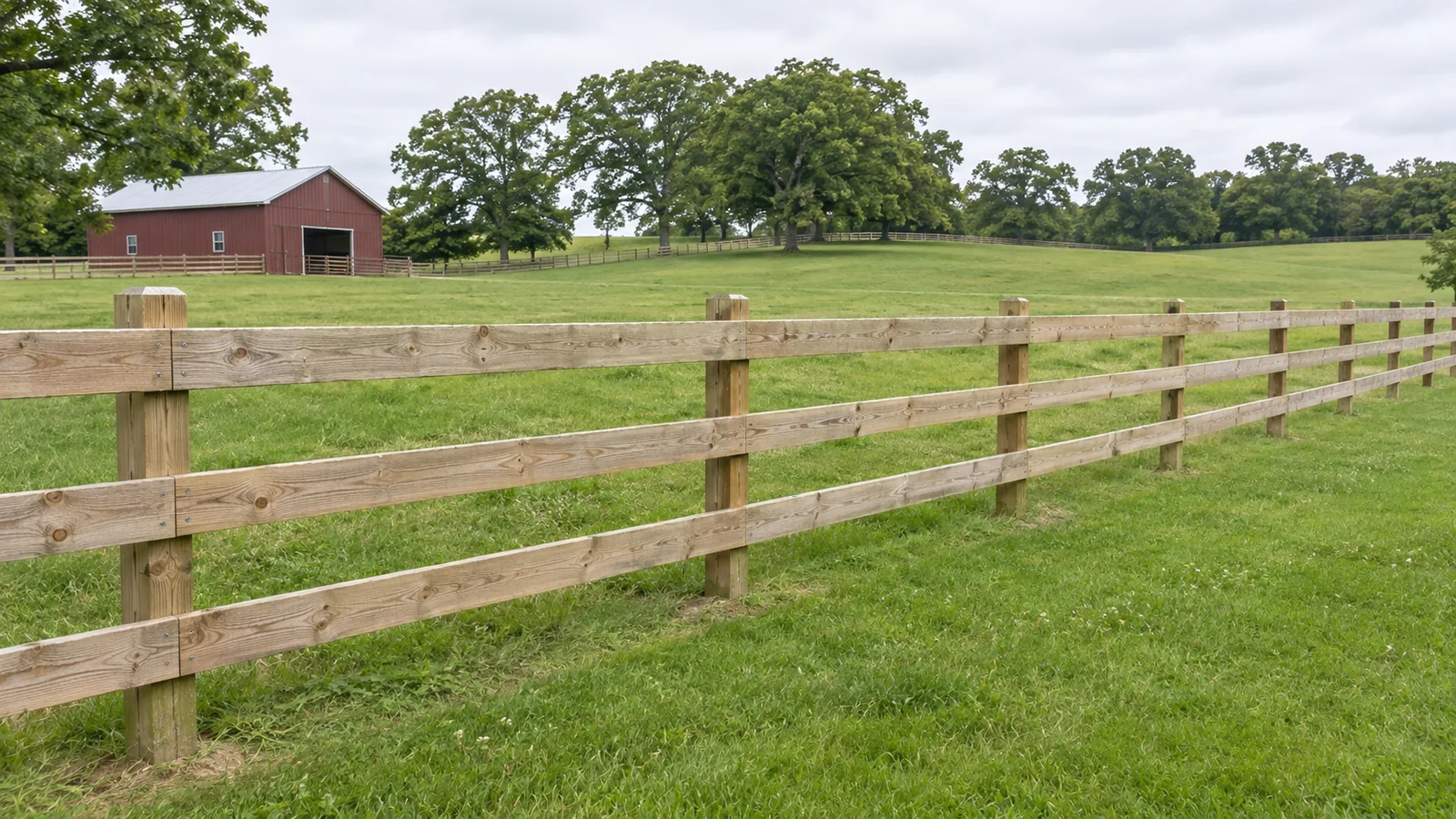
Height is where a horse fence parts from a front-yard one. UGA's bulletin sets 5 ft (60 in) as the minimum for a horse perimeter and allows 4.5 ft (54 in) between pastures. Kevin H. Kline of the University of Illinois, in Safe Fencing for Horses, describes the traditional build as 3 or 4 oak boards, 12 to 16 ft long, cut to 1×6 and nailed to round posts 8 ft long "with 3 feet set underground."
Set the calculator to 5 ft and the frontage list does not change: 39 posts, 114 board spans and 78 bags. Its rule buries each post 2 ft and rounds the post up to the next stock length, so a 5-ft fence still gets 8-ft posts with a foot to spare. That foot can go into the ground, which puts the post at Kline's 3 ft and leaves exactly 5 ft above grade. UGA's own minimum for wooden line posts is 2 ft. In frost country, take the depth from post depth and frost line by state instead.
The two sources also disagree on the bottom gap. UGA puts the bottom of the fence 6 to 8 in off the ground, and Kline sets the bottom board 10 to 12 in up "so that horses do not get their legs trapped beneath it." A fourth board closes the gaps on a 5-ft fence. The calculator stays at three per section, so for four boards multiply the 36 sections by 4: 144 spans, 152 with the same 5% waste.
Post spacing and board length
UGA gives 8 to 10 ft as the normal post spacing for rail fences. On the 300-ft frontage, the spacing setting moves every line except post length and bags per hole:
| Post spacing | Sections | Posts | Board spans with waste | Span length | 80-lb bags |
|---|---|---|---|---|---|
| 6 ft | 48 | 51 | 152 | 6 ft | 102 |
| 8 ft | 36 | 39 | 114 | 8 ft | 78 |
| 10 ft | 29 | 32 | 92 | 10 ft | 64 |
At 10 ft, 288 ft does not divide evenly. You get 28 full sections and an 8-ft one, and 16-ft boards no longer pair up, so you buy 10-ft or 20-ft stock instead. Going to 6 ft adds 12 posts and shortens every span by 2 ft, and 6-ft spans cut evenly from 12-ft boards. The fence post spacing calculator finds an even spacing for a length that leaves a short bay.
White, black or bare wood
Kline writes that board fences "are most often painted white or black with an asphalt based paint," and that the black is diluted asphalt driveway or roofing sealant. Color changes no line in the count, and the paint itself is not on the list.
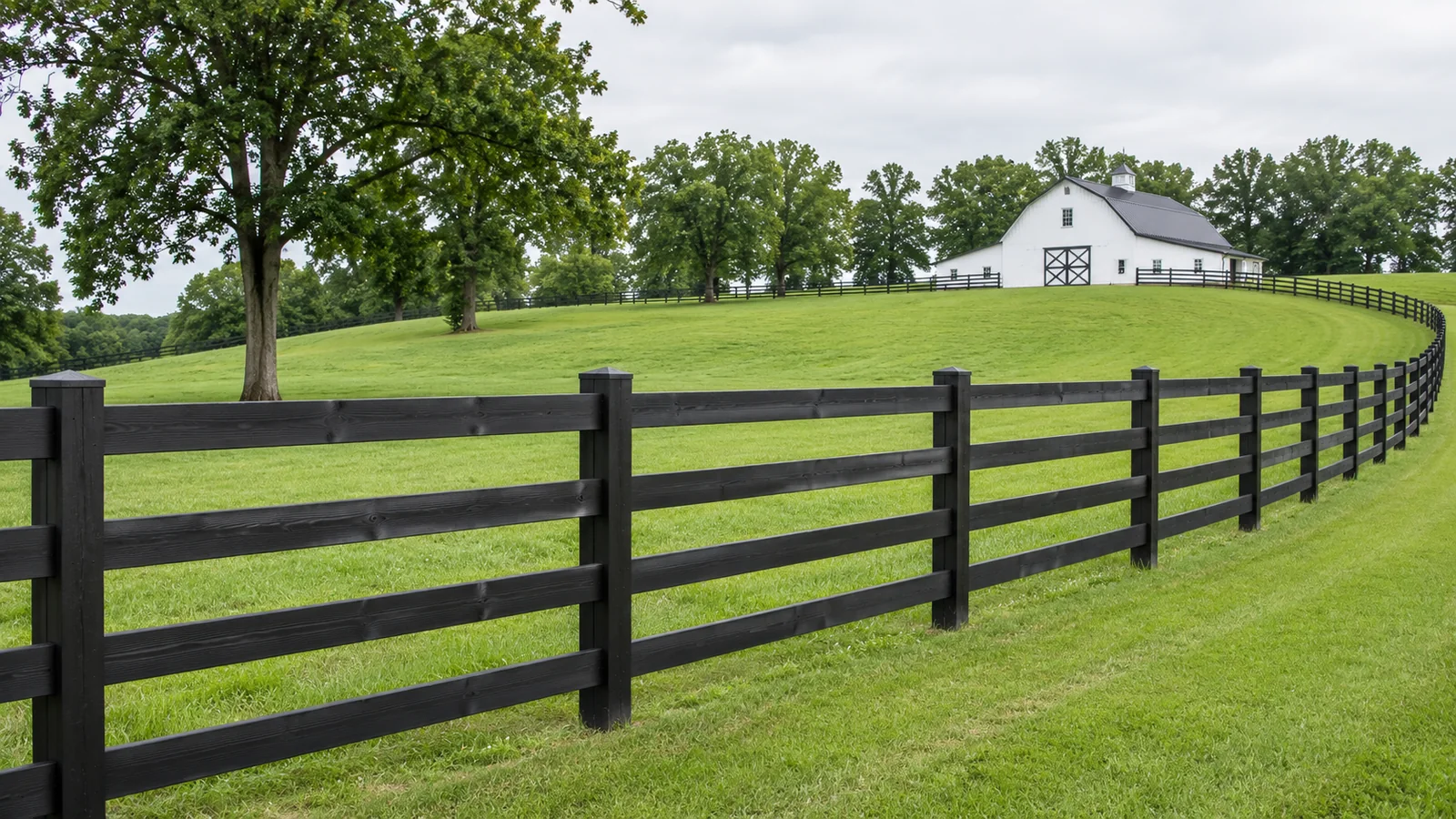
UGA notes that 1×6 boards cost less than 2×6 but warp more and are weaker. Kline lists horses chewing the wood as a maintenance cost. In the illustration above, the 4-board fence rides over rolling ground. On a fence like that, measure the length along the ground and not off a map, because the boards follow the slope.
Gates and the driveway
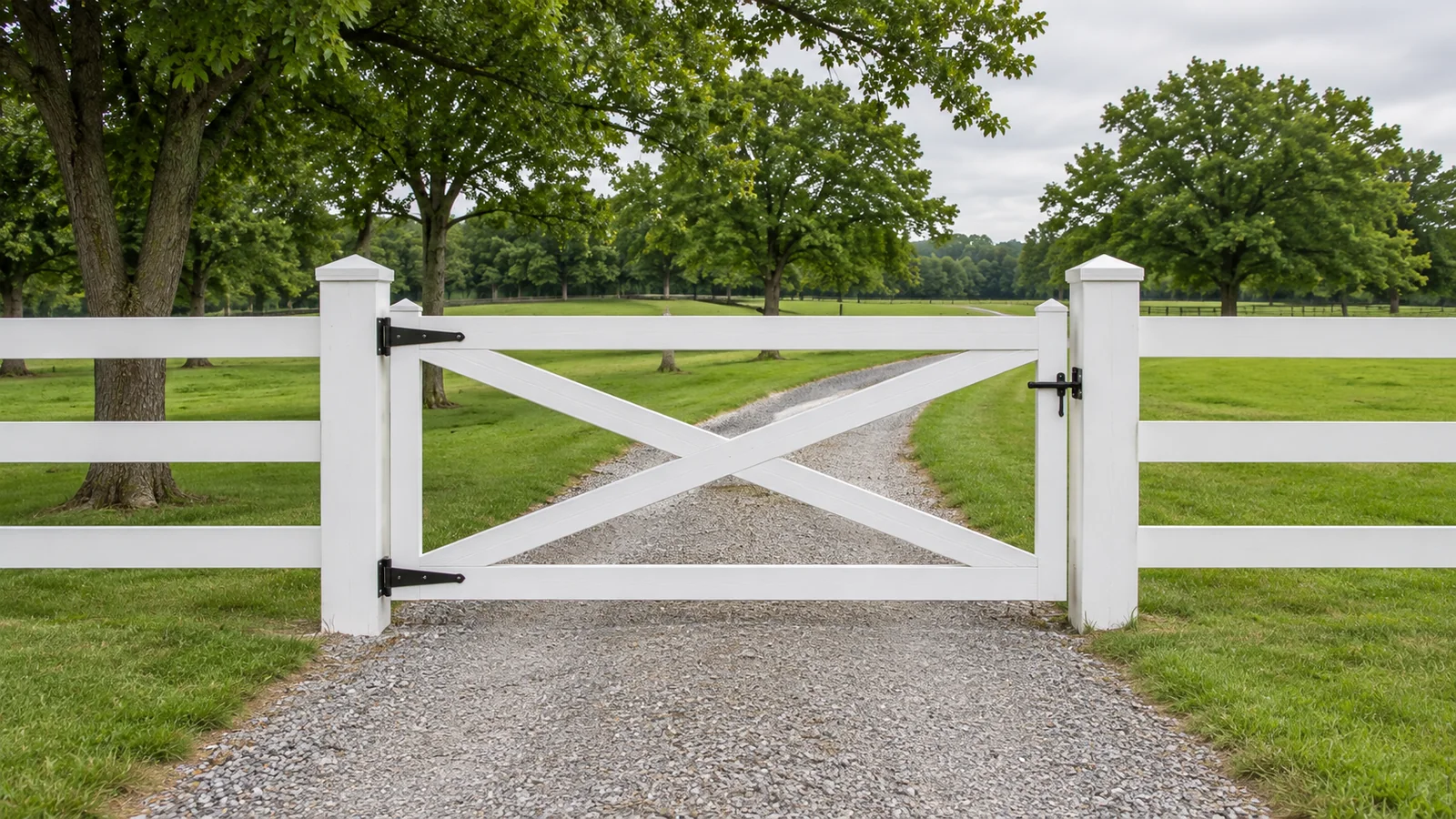
The 12-ft drive gate removes 12 ft from the fence line and adds 2 gate posts. The crossbuck farm gate in the illustration hangs on strap hinges. Its weight hangs on one post. The Post Size setting applies to every post, and switching it to 6×6 widens each hole to 12 in: still 2 bags of 80-lb mix per post, but 4 instead of 3 in 50-lb bags. The concrete per fence post calculator sizes a single heavier gate post on its own.
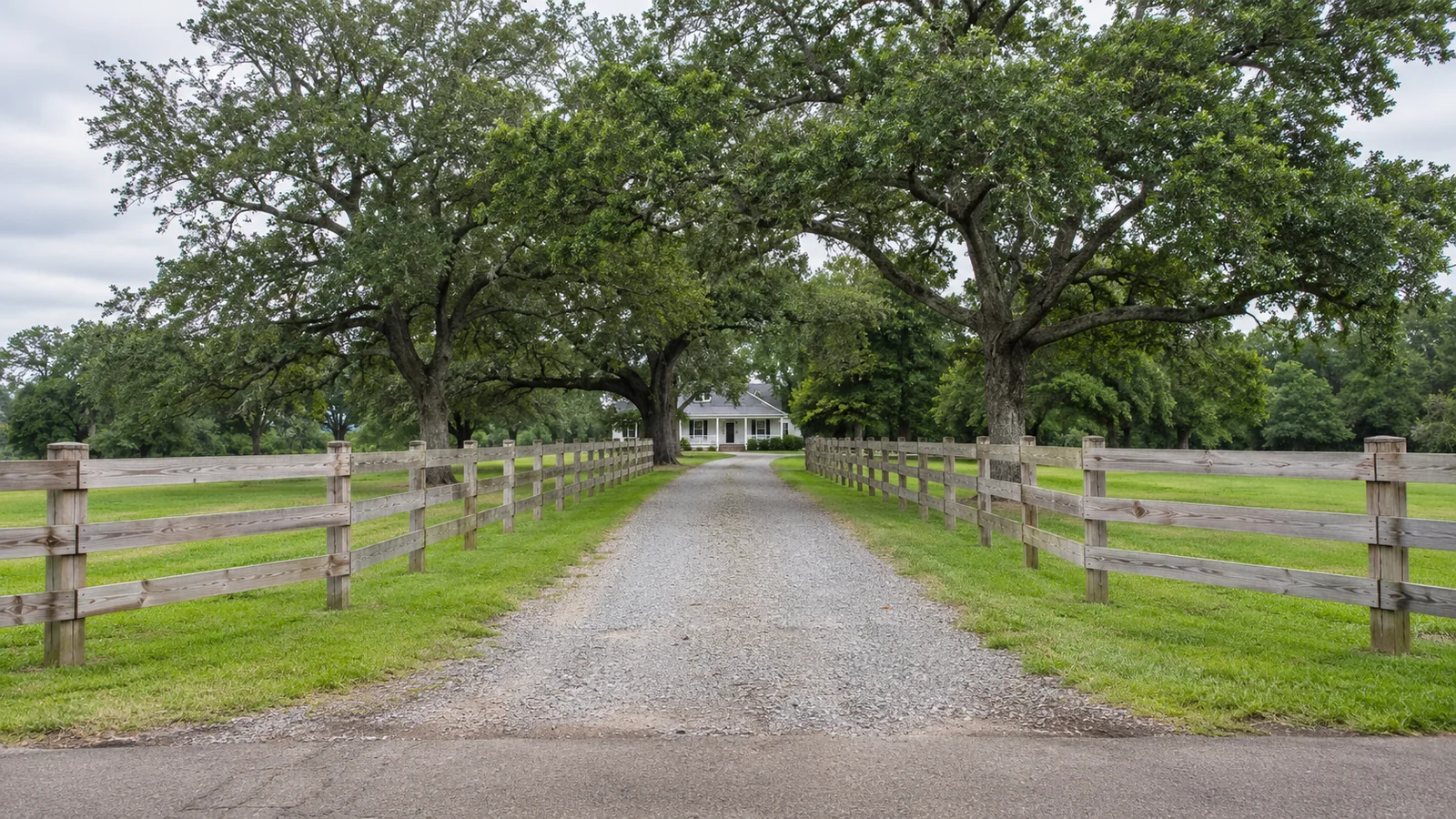
A fence lining both sides of a long lane is two runs with no gate in them. A 400-ft driveway lined on both sides is 800 ft of fence, entered as two runs of 400.
What does a 3-board fence cost?
The national cost table prices a 4-ft ranch rail fence at an estimated $18.20 a foot installed at mid range. It is an estimate: no 2026 source priced 3-board fence on its own, so the table sets it beside wood split rail with a small premium for the third rail, and at 4 ft the two rates land within 20 cents of each other. Entered in the fence cost calculator as 288 ft of Ranch Rail Fence with one drive gate, the frontage comes to about $6,040, permit included. The gate is 11% of that. At 5 ft, the horse-fence height, the same job costs 14% more. To fence a pasture rather than a frontage, the cost to fence an acre page turns acres and lot shape into feet of fence.
Key Takeaways
- On the frontage, 6-ft post spacing needs 31% more posts than 8 ft, and 10-ft spacing 18% fewer.
- The calculator's 10-in hole and 2 bags per post stay the same at 4 and 5 ft, because both heights take a 2-ft bury.
- Wood split rail and ranch rail come out within 1% of each other on the same 288 ft with one drive gate.
- In 60-lb bags, the frontage's concrete comes to 117 bags.
Frequently Asked Questions
Which side of the posts do the boards go on?
On a horse fence, the side the horses are on, so that, in Kline's words, the horse "does not run into the fence post." The calculator's count is the same on either face.
Can I use 2×6 boards instead of 1×6?
Yes, and the count stays at 114 spans for the frontage. UGA calls 2×6 rails stronger and less prone to warping, at a higher price.
How deep should the posts be for a 3-board fence?
The calculator sets 2 ft for every post at 4 and 5 ft. Kline's traditional horse fence sets 8-ft posts 3 ft down, and UGA asks for at least 2 ft on line posts and deeper settings in sand or wet soil.
Does a farmhouse fence need concrete?
The calculator assumes it, at 78 bags of 80-lb mix for the frontage. Every other line on the list is the same without concrete.
Sources
- John W. Worley, Fences for Horses, UGA Cooperative Extension Bulletin 1192, published with full review May 31, 2024. https://fieldreport.caes.uga.edu/publications/B1192/
- Kevin H. Kline, Safe Fencing for Horses, University of Illinois (PDF dated July 15, 2004, reprint hosted by UW–Madison Extension, Walworth County), accessed November 1, 2026. https://walworth.extension.wisc.edu/files/2015/02/Safe_fencing-IL-extension.pdf